Multi-color printing methods in screen printing

Multi-color printing methods in screen printing
With the rapid development of screen printing technology, the increasing complexity and diversity of screen printing processes and materials have led to better and better screen printing effects, which can meet the requirements of more and more customers for printing effects. It has increasingly become the most commonly used printing process in the printing of clothes and other products. To obtain an ideal screen printing product that meets the design requirements, in addition to the selection of screen printing materials and pigments, Nowadays, more and more silk-screen printing patterns require multi color printing. Multi color printing is achieved by using screen printing technology to superimpose and overprint multiple colors on the same printing position, thereby realizing the effect of multi color.
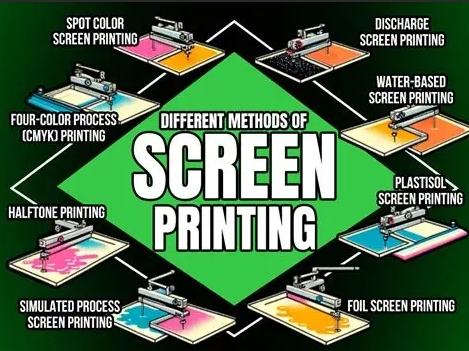
However, as we all know, in screen printing process, we can only printing one color at one time. Therefore, the screen printing of multi-color and different shades of the same color series patterns all require multiple prints. When printing more than one times, it is necessary to ensure that the relative position of each printing does not move. In this way, it is important to know how to fix the location of the screen printing board and the substrate to ensure the precise overlap of multiple printing locations.
There are two method. One is “screen printing on ink pad”, which means the screen printing board is fixed and move the substrate to screen print. The other one is called “flatbed screen printing” which means the substrate is fixed and move the screen printing board while printing. Both these two methods are used for manual screen printing.

Before screen printing, a necessary work is to test the tension of the screen printing board. The tension of the screen is an important control factor. A screen with too low tension will cause the screen to separate slowly from the printed surface, affecting the stability of the color. Meanwhile, the continuous stretching state reduces the service life of the screen. Moreover, it deforms the pattern, elongates the imprints vertically, and even causes varying degrees of elongation horizontally. However, using deformed screen frames will affect the registration accuracy. Therefore, good mesh frames should be selected. According to the actual situation of the pattern, select polyester screen printing mesh of different mesh counts. Its tension is then appropriately adjusted according to the mesh count of the screen printing mesh. An increase in mesh count leads to a decrease in tension, while a decrease in mesh count results in an increase in tension, thereby preventing the mesh from tearing due to excessive tension.
In order to ensure the correspondence of the screen printing board and the substrate, we can use the following two methods. First, the horizontal and vertical edges of the printing table are used for positioning. During printing, the screen plate is also positioned along the edges of the printing brush table to ensure the same position for multiple prints.
Second, Some items themselves have holes, cavities, slits, notches, etc. Two to three holes can be used as positioning holes. Positioning nails can be nailed to the printing table. The height of the positioning nails should be slightly lower than the thickness of the printed item to avoid affecting the printing. Similarly, corresponding positioning positions are also made on the screen printing board, so that precise positioning can be achieved multiple times.
Third, vacuum adsorption positioning: For small or thin substrates, the suction holes on the operation table with vacuum negative pressure suction holes hold the objects to be printed, making them less likely to move and thus achieving positioning.
Fabric screen printing, due to the subtractive color development of the printing paste, will cause color staining when colors overlap. Moreover, fabric printing pastes are mostly transparent pastes. Therefore, in principle, dark colors should be printed first, followed by light colors. Generally, when applying both regular and special print designs on the same thread of printed matter, the regular print should be printed first, followed by the special print. For the sake of precision, if the printing area of a certain color in a pattern is significantly different from that of another color, it is usually the case that the color of the smaller pattern is printed first, followed by the color of the larger pattern.
Difference Between Screen Printing and Pad Printing
Application of nylon mesh in filtration industry
Related Article